The maths of pitch, frequency and rhythm
From clicks to chords
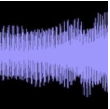
How is frequency related to pitch? That's a topic that's always fascinated me, as well as being rather fundamental to the practice of music! And it was one of the things that came up in my recent conversation on the Maths on the Move podcast, where we were discussing some of the many ways in which maths and music are connected.
A musical note’s pitch is described by the number of oscillations-per-second it exhibits as a sound wave. A sound wave is a pattern of waves through air, similar to the ripples in a pond. Except that ripples make the surface of the pond oscillate up and down, which would be at 90 degrees to the direction of travel of the waves, something called a transverse wave. Instead a sound wave oscillates the air by compressing and rarefacting the air in the same direction as the sound wave is travelling. Such waves are called longitudinal waves.
The frequency of any wave is measured in Hertz (Hz), which is the number of oscillations per second. Human hearing runs from extremely low notes of around 20Hz (20 oscillations per second) to the extremely high notes of around 20,000Hz, (20,000 oscillations per second). As our brains aren’t capable of perceiving each individual oscillation even at the lowest end of that range, we experience them as what we call pitch. For example, the orchestral tuning note of A above middle C is 440Hz. This means when strings, woodwind and pipes play an A, they are all generating soundwaves at a base rate of 440 per second.
Right. Let’s dive into some fun audio!
READ FULL ARTICLE (FOR FREE) ON PLUS MATHS:
https://plus.maths.org/content/clicks-chords-0